Showing posts with label eat the rich. Show all posts

Wednesday, June 3, 2015

The End of the Supermanager?

[I am transitioning my blog over to my new site, but for now I will continue to crosspost stuff here.]


Everyone is talking about this new paper, Firming Up Inequality. It uses individual-level data from the Social Security Administration, matched to employers by Employer Identification Number (EIN), to decompose changes in earnings inequality into a within-firm and a between-firm component. It's a great exercise -- marred only modestly by the fact that the proprietary data means that no one can replicate it -- exactly the sort of careful descriptive work I wish more economists would do.

The big finding from the paper is that all the rise in earnings inequality between 1982 and 2012 is captured by the between-firm component. There is no increase in the earnings of a person in the top 1% of the earnings distribution within a given business, and the earnings of someone at the median for that same business. The whole increase in earnings inequality over this period consists of a widening gap between the firms that pay more across the board, and the firms that pay less.

 I'm not sure we want to take the results of this study at face value. Yes, we should be especially interested in empirical work that challenges our prior beliefs, but at the same time, it's hard to square the claims here with all the other evidence of a disproportionate increase in the top pay within a given firm. Lawrence Mishel gives some good reasons for skepticism here. The fact that the whole increase is accounted for by the between-firm component, yet none by the between-industry component, is very puzzling. More generally, I wonder how reliable is the assumption that there is a one to one match between EINs and what we normally think of as employers.

 That said, these findings may be pointing to something important. As a check on the plausibility of the numbers in the paper, I took a look at labor income of the top 1 percent and 0.01 percent of US households, as reported in the World Top Incomes Database. And I found something I didn't expect: Since 2000, there's been a sharp fall in the share of top incomes that come from wages and salaries. In 2000, according to the tax data used by Piketty and his collaborators, households in the top 0.01 percent got 61 percent of their income from wages, salaries and pensions. By 2013, that had fallen to just 33 percent. (That's excluding capital gains; including them, the labor share of top incomes fell from 31 percent to 21 percent.) For the top 1 percent, the labor share falls from 63 percent to 56 percent, the lowest it's been since the 1970s.

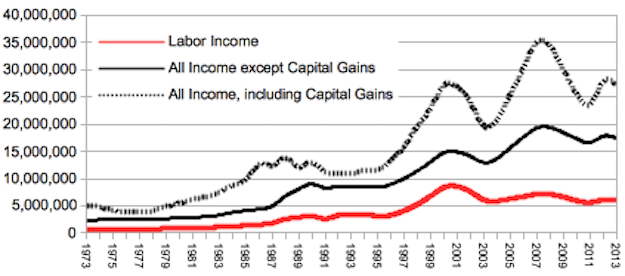
 Here is the average income of the top 0.01 percent over the past 40 years in inflation-adjusted dollars, broken into three components: labor income, all other non-capital gains income, and capital gains.

01percent_income
Average income of top 0.01% of US households, from World Top Incomes Database. 3-year moving averages.

As you can see, the 1990s look very different from today. Between 1991 and 2000, the average labor income of a top 0.01% household rose from $2.25 million to $10 million; this was about 90 percent of the total income increase for these households. During the 1990s, rising incomes at the top really were about highly paid superstars. Since 2000, though, while average incomes of the top 0.01% have increased another 20 percent, labor income for these households has fallen by almost half, down to $5.5 million. (Labor income has also fallen for the top 1 percent, though less dramatically.) So the "Firming" results, while very interesting, are perhaps less important for the larger story of income distribution than both the authors and critics assume. The rise in income inequality since 2000 is not about earnings; the top of the distribution is no longer the working rich. I don't think that debates about inequality have caught up with this fact.

 Fifteen years ago, the representative rich person in the US was plausibly a CEO, or even an elite professional. Today, they mostly just own stuff.

Monday, April 7, 2014

Wealth Distribution and the Puzzle of Germany

There’s been some discussion recently of the new estimates from Emmanuel Saez and Gabriel Zucman of the distribution of household wealth in the US. Using the capital income reported in the tax data, and applying appropriate rates of return to different kinds of assets, they are able to estimate the distribution of household wealth holdings going back to the beginning of the income tax in 1913. They find that wealth inequality is back to the levels of the 1920s, with 40% of net worth accounted for the richest one percent of households. The bottom 50% of households have a net worth of zero.

There’s a natural reaction to see this as posing the same kind of problem as the distribution of income — only more extreme — and respond with proposals to redistribute wealth. This case is argued by the very smart Steve Roth in comments here and on his own blog. But I’m not convinced. It’s worth recalling that proposals for broadening the ranks of property-owners are more likely to come from the right. What else was Bush’s “ownership society”? Social Security privatization, if he’d been able to pull it off, would have  dramatically broadened the distribution of wealth. In general, I think the distribution of wealth has a more ambiguous relationship than the distribution of income to broader social inequality.

Case in point: Last summer, the ECB released a survey of European household wealth. And unexpectedly, the Germans turned out to be among the poorest people in Europe. The median German household reported net worth of just €50,000, compared with €100,000 in Greece, €110,000 in France, and €180,000 in Spain. The pattern is essentially the same if you look at assets rather than net worth — median household assets are lower in Germany than almost anywhere else in Europe, including the crisis countries of the Mediterranean.

At the time, this finding was mostly received in terms the familiar North-South morality tale, as one more argument for forcing austerity on the shiftless South. Not only are the thrifty Germans being asked to bail out the wastrel Mediterraneans, now it turns out the Southerners are actually richer? Why can't they take responsibility for their own debts? No more bailouts!

No surprise there. But how do we make sense of the results themselves, given what we know about the economies of Germany and the rest of Europe? I think that understood correctly, they speak directly to the political implications of wealth distribution.

First, though: Did the survey really find what it claimed to find? The answer seems to be more or less yes, but with caveats.

Paul de Grauwe points out some distortions in the headline numbers reported by the ECB. First, this is a survey of household wealth, but, de Grauwe says, households are larger in the South than in the North. This is true, but it turns out not to make much of a difference -- converting from household wealth to wealth per capita leaves the basic pattern unchanged.

Per capita wealth in selected European countries. From de Grauwe.


Second, the survey focuses on median wealth, which ignores distribution. If we look at the mean household instead of the median one, we find Germany closer to the middle of the pack -- ahead of Greece, though still behind France, Italy and Spain. The difference between the two measures results from the highly unequal distribution of wealth in Germany -- the most unequal in Europe, according to the ECB survey. For the poorest quintile, median net worth is ten times higher in Greece and in Italy than in Germany, and 30 times higher in Spain.

This helps answer the question of apparent low German wealth — part of the reason the median German household is wealth-poor is because household wealth is concentrated at the top. But that just raises a new puzzle. Income distribution Germany is among the most equal in Europe. Why is the distribution of wealth so much more unequal? The puzzle deepens when we see that the other European countries with high levels of wealth inequality are France, Austria, and Finland, all of which also have relatively equal income distribution.

Another distortion pointed to by De Grauwe is that the housing bubble in southern Europe had not fully deflated in 2009, when the survey was taken — home prices were still significantly higher than a decade earlier. Since Germany never had a housing boom, this tends to depress measured wealth there. This explains some of the discrepancy, but not all of it. Using current home prices, the median Spanish household has more than triple the net wealth of the median German household; with 2002 home prices, only double. But this only moves Germany up from the lowest median household wealth in Europe, to the second lowest.


The puzzle posed by the wealth survey seems to be genuine. Even correcting for home prices and household size, the median Spanish or Italian household reports substantially more net wealth than the median German one, and the median Greek household about an equal amount. Yet Germany is, by most measures, a much richer country, with median household income of €33,000, compared with €22,000, €25,000 and €26,000 in Greece, Spain and Italy respectively. Use mean wealth instead of median, and German wealth is well above Greek and about equal to Spanish, but still below Italian — even though, again, average household income is much higher in Germany than in Italy. And the discrepancy between the median and mean raises the puzzle of why German wealth distribution is so much more uneven than German income distribution.

De Grauwe suggests one more correction: look at the total stock of fixed capital in each country, rather than household wealth. Measuring capital consistently across countries is notoriously dicey, but on his estimate, Germany and the Netherlands have as much as three times the capital per head as the southern countries. So Germany is richer in real terms than the South, as we all know; the difference is just that "a large part of German wealth is not held by households and therefore must be held by the corporate sector." Problem solved!

Except... you know, Mitt Romney was right: corporations are people, in the sense that they are owned by people. The wealth of German corporations should also show up as the wealth of the owners of German stocks, bonds, or other claims on those corporations -- which means, overwhelmingly, German households. Indeed, in mainstream economic theory, the "wealth" of the corporate sector just is the wealth of the households that own it. According to de Grauwe, the per capita value of the capital stock is more than twice as large in Germany as in Spain. Yet the average financial wealth held by a German household is only 25% higher than in Spain. So as in the case of distribution, this solution to the net-wealth puzzle just creates a new puzzle: Why is a dollar of capital in a German firm worth so much less to its ultimate owners than a dollar of capital in a Spanish or Italian firm?

And this, I think, points us toward the answer, or at least toward the right question.

The question is, what is the relationship between the level of market production in an economy, and the claims on future production represented by wealth? It’s a truism — tho often forgotten — that the market production counted in GDP is only a part of all the productive activity that takes place in society. In the same way, not all market production is capitalized into assets. Wealth in an economic sense represents only those claims on future income that are exercised by virtue of a legal title that is freely transferable, and hence has a market value.

For example, imagine two otherwise similar countries, one of which makes provision for retirement income through a pay-as-you-go public pension system, and the other of which uses some form of funded pension. The two countries may have identical levels of output and income, and retirees may receive exactly the same payments in both. But because the assets held by the pension funds show up on balance sheets while the right to future public pension payments does not, the first country will have less wealth than the second one. Again, this does not imply any difference in production, or income, or who ultimately bears the cost of supporting retirees; it is simply a question of how much of those future payments are capitalized into assets.

This is just an analogy; I don't think retirement savings are the story here. The story is about home ownership and the value of corporate stock.

First, home ownership. Only 44 percent of German households own their own homes, compared with 70-80 percent in Greece, Italy and Spain. Among both homeowners and non-homeowners considered separately, median household wealth is comparable in Germany and in the southern countries. It’s only the much higher proportion of home ownership that produces higher median wealth in the South. And this is especially true at the bottom end of the distribution — almost all the bottom quintile (by income) of German households are renters, whereas in Greece, Spain and Italy there is a large fraction of homeowners even at the lowest incomes. Furthermore, German renters have far more protections than elsewhere. As I understand it, German renters are sufficiently protected against both rent increases and loss of their lease that their occupancy of their home is not much less secure than that of home owners. These protections are, in a sense, a form of property right — they are a claim on the future flow of housing services in the same way that a title to a house would be. But with a critical difference: the protections from rent regulation can’t be sold, don’t show up on the household’s balance sheet, and do not get counted as wealth.

In short: The biggest reason that German household wealth is lower than than elsewhere is that less claims on the future output of the housing sector take the form of assets. Housing is just as commodified in Germany as elsewhere (I don’t think public housing is unusually important there). But it is less capitalized.

Home ownership is the biggest and clearest part of the story here, but it’s not the whole story. Correct for home ownership rates, use mean rather than median, and you find that German household wealth is comparable to household wealth in Italy or Spain. But given that GDP per capita is much higher in Germany, and the capital stock seems to be so much larger, why isn't household wealth higher in Germany too?

One possible answer is that income produced in the corporate sector is also less capitalized in Germany.

In a recent paper with Zucman, Thomas Piketty suggests that the relationship between equity values and the real value of corporate assets depends on who exercises power over the corporation. Piketty and Zucman:
Investors who wish to take control of a corporation typically have to pay a large premium to obtain majority ownership. This mechanism might explain why Tobin’s Q tends to be structurally below 1. It can also provide an explanation for some of the cross-country variation… : the higher Tobin’s Q in Anglo-Saxon countries might be related to the fact that shareholders have more control over corporations than in Germany, France, and Japan. This would be consistent with the results of Gompers, Ishii and Metrick (2003), who find that firms with stronger shareholders rights have higher Tobin’s Q. Relatedly, the control rights valuation story may explain part of the rising trend in Tobin’s Q in rich countries. … the ”control right” or ”stakeholder” view of the firm can in principle explain why the market value of corporations is particularly low in Germany (where worker representatives have voting rights in corporate boards without any equity stake in the company). According to this ”stakeholder” view of the firm, the market value of corporations can be interpreted as the value for the owner, while the book value can be interpreted as the value for all stakeholders.
In other words, one reason household wealth is low in Germany is because German households exercise their claims on the business sector not via financial assets, but as workers.

The corporate sector is also relatively larger in Germany than in the southern countries, where small business remains widespread. 14 percent of Spanish households and 18 percent of Italian households report ownership of a business, compared with only 9 percent of German households. Again, this is a way in which lower wealth reflects a shift in claims on the social product from property ownership to labor.

It’s not a coincidence that Europe’s dominant economy has the least market wealth. The truth is, success in the world market has depended for a long time now on limiting dependence on asset markets, just as the most successful competitors within national economies are the giant corporations that suppress the market mechanism internally. Germany, as with late industrializers like Japan, Korea, and now China, has succeeded largely by ensuring that investment is not guided by market signals, but through active planning by banks and/or the state. There’s nothing new in the fact that greater real wealth in the sense of productive capacity goes hand hand with less wealth in the sense of claims on the social product capitalized into assets. Only in the poorest and most backward countries does a significant fraction of the claims of working people on the product take the form of asset ownership.

The world of small farmers and self-employed artisans isn’t one we can, or should, return to. Perhaps the world of homeowners managing their own retirement savings isn’t one we can, or should, preserve.
Thursday, March 28, 2013

Where Do the Rich Get Their Money, Again?

This was an early topic at the Slack Wire, but worth revisiting.

There's this widespread idea that the rich today are no different from us. We no longer have the pseudo-aristocratic rentiers of Fitzgerald or Henry James, but hard-working (if perhaps overcompensated) superstars of the labor market. When a highbrow webzine does an "interview with a rich person," it turns out to be a successful graphic designer earning $140,000 a year.

Sorry, that is not a rich person.

The 1 percent cutoff for household income is around $350,000. The 0.1 percent, around $2 million. The 0.01 percent, around $10 million. Those are rich people, and they're not graphic designers, or even lawyers or bankers. They're owners.

From the IRS Statistics of Income for 2010:


Wages and Salaries Pensions, Social Security, UI Interests, Dividends, Inheritance Business Income Capital Gains Total Capital Income

Total 64.5% 18.5% 6.1% 7.2% 3.8% 17.1%

Median Household 72.7% 21.5% 2.4% 2.4% 0.0% 4.8%

The 0.01% 14.6% 0.7% 23.1% 19.0% 40.6% 82.7%


As we can see, for households at the very top of the distribution, income overwhelmingly comes from property ownership. Total property income at the far right, the sum of preceding three columns. (The numbers don't add to quite 100% because I've left out a few small, hard-to-classify categories like alimony and gambling winnings.) The top 0.01 percent's 15 percent of labor income is not much more than the same stratum got from wages and salaries in 1929. No doubt many of these people spend time at an office of some kind, but the idea of "the working rich" is a myth.

Here's the same breakdown across the income distribution. The X-axis is adjusted gross income.


So across a broad part of the income distribution, wages make up a stable 70-75 percent of income, with public and private social insurance providing most of the rest. Capital income catches up with labor income around $500,000, making the one percent line a good qualitative as well as quantitative cutoff. It's interesting to see how business income peaks in the $1 to $2 million range, the signature of the old middle class or petite bourgeoisie. And at the top, again, capital income is absolutely dominant.

It's an interesting question why this isn't more widely recognized. Mainstream discussions of rising inequality take it for granted that “those at the top were more likely to earn than inherit their riches," with the clear understanding that "earn" means a paycheck. Even very smart Marxists like Gerard Dumenil and Dominique Levy concede that "a large fraction of the income of the wealthiest segments of the population is made of wages," giving a figure of 48.8 percent for the wage share of the top 0.1 percent. Yet the IRS figures show that the wage share for this stratum is not nearly half, but less than a third. What gives?

I think at least some of the confusion is the fault of Piketty and Saez. Their income distribution work is state of the art, they've done as much as anyone to bring the concentration of income at the top into public discussion; I'd be a fool to criticize their work on the substance. They do, however, make a somewhat peculiar choice about presentation. In the headline numbers in much of their work, they give not the top 0.01, 0.1, 1, etc. percent by income, but rather the top percentiles by income excluding capital gains. [*] This is clearly stated in their papers but it is almost never noted, as far as I can tell, by people who cite them.

There are various good reasons, in principle, for distinguishing capital gains from other income. But in an era when capital gains are the largest single source of income at the top, defining top income fractiles  excluding capital gains seriously distorts your picture of the very top. For instance, you may miss people like this guy: In both 2010 and 2011, the majority of Mitt Romney's income took the form of capital gains.

"They have taken untold millions that they never toiled to earn," or if you prefer, "Save your money -- same like yesterday."


[*] The fractiles are defined this way even when capital gains income is reported. You have to dig around a bit in their data to find the composition of income by raw income fractiles, equivalent to my table above.

Wednesday, October 31, 2012

Perspective

"Storm surge barriers, the huge sea gates that some scientists say would be the best protection against floods, could cost as much as $10 billion."

Meanwhile, according to the IRS, the 35,000 New York households who make over $1 million have a total annual income of $135 billion.

Just saying.

Friday, September 21, 2012

You Eat Mitt Romney's Salt

Don't you love the Romney video? I'm not going to deny it, right now I am with Team Dem. It's true, we usually say "the bosses have two parties"; but it's not usual for them to run for office personally, themselves. And when they do, wow, what a window onto how they really think.

It's hard to even imagine the mindset where the person sitting in the back of the town car is the "maker" and the person upfront driving is just lazing around; where the guys maintaining the hedges and manning the security gates at the mansion are idle parasites, while the person living in it, just by virtue of that fact, is working; where the person who owns the dressage horse is the producer and the people who groom it and feed it and muck it are the layabouts. As some on the right have pointed out, it's weird, also, that "producing" is now equated with paying federal taxes. Isn't working in the private sector supposed to be productive? Isn't a successful business contributing something to society besides checks to the IRS?

It is weird. But as we're all realizing, the 47 percent/53 percent rhetoric has a long history on the Right. (It would be interesting to explore this via the rounding-up of 46.4 percent to 47, the same way medievalists trace the dissemination of a text by the propagation of copyists' errors.) Naturally, brother Konczal is on the case, with a great post tracing out four lineages of the 47 percent. His preferred starting point, like others', is the Wall Street Journal's notorious 2002 editorial on the "lucky duckies" who pay no income tax.

That's a key reference point, for sure. But I think this attitude goes back a bit further. The masters of mankind, it seems to me, have always cultivated a funny kind of solipsism, imagining that the people who fed and clothed and worked and fought for them, were somehow living off of them instead.

Here, as transcribed in Peter Laslett's The World We Have Lost, is Gregory King's 1688 "scheme" of the population of England. It's fascinating to see the careful gradations of status (early-moderns were nothing if not attentive to "degree"); we'll be pleased to see, for instance, that "persons in liberal arts and sciences," come above shopkeepers, though below farmers. But look below that to the "general account" at the bottom. We have 2.675 million people "increasing the wealth of the kingdom," and 2.825 million "decreasing the wealth of the kingdom." The latter group includes not only the vagrants, gypsies and thieves, but common seamen, soldiers, laborers, and "cottagers," i.e. landless farmworkers. So in three centuries, the increasers are up from 49 percent to 53 percent, and the lucky duckies are down from 51 percent to 47. That's progress, I guess.


One can't help wondering how the wealth of the kingdom would hold up if the eminent traders by sea couldn't find common seamen, if the farmers had to do without laborers, if there were officers but no common soldiers. 
Young Alexander conquered India.
He alone?
Caesar beat the Gauls.
Was there not even a cook in his army?
Always more where they come from, I suppose Gregory King might say.

Here, also from Laslett, is a similar division from 100 years earlier, by Sir Thomas Smith:
1. ‘The first part of the Gentlemen of England called Nobilitas Major.’ This is the nobility, or aristocracy proper.
2. ‘The second sort of Gentlemen called Nobilitas Minor.’ This is the gentry and Smith further divides it into Knights, Esquires and gentlemen.
3. ‘Citizens, Burgesses and Yeomen.’
4. ‘The fourth sort of men which do not rule.’
Of this last group, Smith explains:
The fourth sort or class amongst us is of those which the old Romans called capite sensu proletarii or operarii, day labourers, poor husbandmen, yea merchants or retailers which have no free land, copyholders, and all artificers, as tailors, shoemakers, carpenters, brick- makers, brick-layers, etc. These have no voice nor authority in our commonwealth and no account is made of them, but only to be ruled and not to rule others.
In other words, Elizabethan Mitt Romney, your job is not to worry about those people.

Smith's contemporary Shakespeare evidently had distinctions like these in mind when he wrote Coriolanus. (A remarkably radical play; I think it was the only Shakespeare Brecht approved of.) The title chracter's overriding passion is his contempt for the common people, those "geese that bear the shapes of men," who "sit by th' fire and presume to know what's done i' the Capitol." He hates them specifically because they are, as it were, dependent, and think of themselves as victims.
They said they were an-hungry; sigh'd forth proverbs, --
That hunger broke stone walls, that dogs must eat,
That meat was made for mouths, that the gods sent not
Corn for the rich men only: -- with these shreds
They vented their complainings...
He has no patience for this idea that people are entitled to enough to to eat:
Would the nobility lay aside their ruth
And let me use my sword, I'd make a quarry
With thousands of these quarter'd slaves, as high
As I could pick my lance.
One more instance. Did everybody read Daniyal Mueenuddin's In Other Rooms, Other Wonders?

It's a magnificent, but also profoundly conservative, work of fiction. In Mueenuddin's world the social hierarchy is so natural, so unquestioned, that any crossing of its boundaries can only be understood as a personal, moral failing, which of course always comes at a great personal cost. There's one phrase in particular that occurs repeatedly in the book: "They eat your salt," "you ate his salt," etc. The thing about this evidently routine expression is that the eater is always someone of lower status, and the person whose salt is being eaten is always a landlord or aristocrat. "Oh what could be the matter in your service? I've eaten your salt all my life," says the electrician who has, in fact, spent all his life keeping the pumps going on the estates of the man he's petitioning. Somehow, in this world, the person who sits in a mansion in Lahore or Karachi is entitled as a matter of course to all the salt and all the good things of life, and the person who physically produces the salt should be grateful to get any of it.

Mueenuddin describes this world vividly and convincingly, in part because he is a writer of great talent, but also clearly in part because he shares its essential values. Just in case we haven't got the point, the collection's final story, "A Spoiled Man," is about how an old laborer's life is ruined when his master's naive American wife gets the idea he deserves a paycheck and proper place to sleep, giving him the disastrous idea that he has rights. You couldn't write fiction like that in this country, I don't think. Hundreds of years of popular struggle have reshaped the culture in ways that no one with the sensitivity to write good fiction could ignore. A Romney is a different story.


UDPATE: Krugman today is superb on this. (Speaking of being on Team Dem.)

Monday, January 23, 2012

I Was Born on the Wrong Continent

... because I want to vote for this guy:

François Hollande, the leading challenger for the French presidency, has described the banking industry as a faceless ruler and his “true adversary”. As he launched in earnest his campaign to become France’s first socialist head of state since the mid-1990s, Mr Hollande said he would seek a Franco-German treaty to overturn the “dominance of finance” and re-orient Europe towards growth and big industrial projects.

At a rally on the outskirts of Paris in front of thousands of supporters on Sunday afternoon, he said: “My true adversary does not have a name, a face, or a party. He never puts forward his candidacy, but nevertheless he governs. My true adversary is the world of finance.” ... Mr Hollande promised, if elected, to separate the investment activities of French banks from their other operations, ban them from tax havens and establish a “public” credit ­rating agency for Europe. He also promised higher taxes for people earning more than €150,000 a year and attacked the “new aristocracy” of today’s super-rich. A financial transaction tax would be introduced, with France acting with other European countries willing to participate....

In a powerful speech that advisers said he had written himself over the weekend, the socialist candidate came out fighting, looking to make an impression on the broader French public by taking aim at some carefully chosen national bêtes noires. These included globalisation, unemployment and shrinking domestic industry. But uppermost were bankers....

“I have always followed the line on which I was fixed,” he said. “I am a socialist. The left did not come to me through heritage. It was necessary for me to move towards it.”
Certain leftists I know will say this is just populist bluster, that nothing is finance's fault, and that this kind of language is just a distraction from genuine radical politics. But it's not all bluster: As Arin D. points out, French bankers seem to have been born on the wrong continent, too.

 Maybe we can arrange a swap?

Wednesday, January 4, 2012

The Bergeron Solution

Does anybody else remember  that Kurt Vonnegut story "Harrison Bergeron"? (It's an early one; he reused the conceit, I think, in one of his novels -- The Sirens of Titan maybe?) The idea is that in a future egalitarian dystopia, perfect fairness is achieved by subjecting everyone to penalties corresponding to their talents -- the physically fit have to wear burdensome weights, smart people like you and me and Kurt have earphones subjecting us to distracting noises, and so on. 

As a story, it's not much -- sort of a Simple English version of The Fountainhead. But I thought of it when I read this post from Nick Rowe last month. Microeconomics isn't normally my bag, but this was fun.

Suppose we have a group of similar people. One of them has to do some unpleasant or dangerous job, defending the border against the Blefuscudians, say. Has to be one person, they can't rotate. So what is the welfare-maximizing way to allocate this bad job? Have a draft where someone is picked by lot and compelled to do it, or offer enough extra pay for it that someone volunteers? You'd think that standard micro would say the market solution is best. But -- well, here's Nick:
The volunteer army is fair ex post. The one who volunteers gets the same level of utility as the other nine. ... The lottery is unfair ex post, because they all get the same consumption but one has a nastier job. That's obvious. What is not obvious, until you think about it, is that ... the lottery gives higher expected utility. That's the result of Theodore Bergstrom's minor classic "Soldiers of Fortune" paper.
The intuition is straightforward. Think about the problem from the Utilitarian perspective, of maximising the sum of the ten utilities. This requires equalising the marginal utility of consumption for all ten men. ... The volunteer army gives the soldier higher consumption, and so lower marginal utility of consumption, so does not maximise total utility. ....
If we assume, as may be reasonable, that taking the job reduces the marginal utility of consumption, that strengthens the advantages of the lottery over the volunteer army. It also means they would actually prefer a lottery where the soldier has lower consumption than those who stays home. The loser pays the winners, as well as risking his life, in the most efficient lottery.
It's a clever argument. You need to pay someone extra to do a crap job. (Never mind that those sorts of compensating differentials are a lot more common in theory than in the real world, where the crappiest jobs are also usually the worst paid. We're thinking like economists here.) But each dollar of consumption contributes less to our happiness than the last one. So implementing the fair outcome leaves everyone with lower expected utility than just telling the draftee to suck it up.

Of course, this point has broader applications. I'd be shocked if some version of it hasn't been deployed as part of an anti-Rawlsian case against social insurance. Nick uses it to talk about CEO pay. That's the direction I want to go in, too.

We all know why Bill Gates and Warren Buffett and Carlos Slim Helu are so rich, right? It's because they sit on top of a vast machine for transforming human lives into commodities market income is equal to marginal product, and Buffet and Gates and Slim and everybody named Walton are just so damn productive. We have to pay them what they're worth or they won't produce all this valuable stuff that no one else can. Right?

The problem is, even if the monstrously rich really were just as monstrously productive, that wouldn't make them utility monsters. Even if you think that the distribution of income is determined by the distribution of ability, there's no reason to think that people's ability to produce and their ability to derive enjoyment from consumption coincide. Indeed, to the extent that being super productive means having less leisure, and means developing your capacity for engineering or order-giving rather than for plucking the hour and the day virtuously and well, they might well be distributed inversely. But even if Paul Allen really does get an ecstasy from taking one of his jets to his helicopter to his boat off the coast of Southern France that we plebes, with our puny so-called vacations [1], can't even imagine, the declining marginal utility of consumption is still going to catch up with him eventually. Two private jets may be better than one, but surely they're not twice as good.

And that, if you believe the marginal product story, is a problem. The most successful wealth-creators will eventually reach a point where they may be as productive as ever, but it's no longer worth their while to keep working. Look at Bill Gates. Can you blame him for retiring? He couldn't spend the money he's got in ten lifetimes, he can't even give it away. But if you believe his salary up til now has reflected his contribution to the social product, his retirement is a catastrophe for the rest of us. Atlas may not shrug, but he yawns.

Wealth blunts the effects of incentives. So we want the very productive to have lots of income, but very little wealth. They should want to work 12 hour days to earn more, but they shouldn't be tempted to cut their hours back to spend what they already earned. It seems like an insoluble problem, closely related to Suresh's superstar doctor problem, which liberalism has no good answer to. [2]

But that's where we come to Harry Bergeron. It's perfectly possible for superstar doctors to have both a very high income and very low wealth. All that's required is that they start in a very deep hole.

If we really believed that the justification for income disparities is to maintain incentives for the productive, we'd adopt a version of the Bergeron plan. We'd have tests early in life to assess people's innate abilities, and the better they scored, the bigger the bill we'd stick them with. If it's important that "he who does not work, neither shall he eat," [3] it's most important for those who have the greatest capacity to work. Keep Bill Gates hungry, and he might have spent another 20 years extracting rents from network externalities creating value for Microsoft's shareholders and customers.

There's no shortage of people to tell you that it might seem unfair that Paul Allen has two private jets in a world where kids in Kinshasa eat only every two days, but that in the long run the tough love of proper incentives will make more pie for everyone. Many of those people would go on to say that the reason Paul Allen needs to be encouraged so strenuously is because of his innate cognitive abilities. But very few of those people, I think, would feel anything but moral outrage at the idea that if people with Allen's cognitive capacities could be identified at an early age, they should be stuck with a very big bill and promised a visit from very big bailiffs if they ever missed a payment. And yet the logic is exactly the same.

Of course I'm not endorsing this idea; I don't think the rich, by and large, have any special cognitive capacities so I'm happy just to expropriate them; we don't have to work them until they drop. (People who do believe that income inequality is driven by marginal productivity don't have such an easy out.)

But it's funny, isn't it: As a society we seem to be adopting something a bit like the Bergeron Solution. People who are very productive, at least as measured by their expected salaries, do begin their lives, or at least their careers, with a very big bill. Which ensures that they'll be reliable creators of value for society, where value is measured, as always, in dollars. God forbid that someone who could be doctor or lawyer should decide to write novels or raise children or spend their days surfing. Of course one doesn't want to buy into some naive functionalism, not to say conspiracy theory. I'm not saying that the increase in student debt happened in order that people who might otherwise have been tempted into projects of self-valorization would continue to devote their lives to the valorization of capital instead. But, well, I'm not not saying that.


[1] What, you think that "family" you're always going on about could provide a hundredth the utility Paul Allen gets from his yacht?

[2] That post from Suresh is where I learned about utility monsters.

[3] I couldn't be bothered to google it, but wasn't it Newt's line back in the day, before Michele Bachman picked it up?

Monday, June 6, 2011

Political Economy 101

When he's right, he's right:
everything we’re seeing makes sense if you think of the Right as representing the interests of rentiers, of creditors who have claims from the past — bonds, loans, cash — as opposed to people actually trying to make a living through producing stuff. Deflation is hell for workers and business owners, but it’s heaven for creditors. ... thinking of what’s happening as the rule of rentiers, who are getting their interests served at the expense of the real economy, helps make sense of the situation.
Or, almost right. Because it isn't just the Right...


EDIT: It's interesting to note how reflexively DeLong shied away from this thought when it occurred to him a while back, with the ludicrous-on-its-face argument that only "coupon-clippers with their portfolios 100% in government bonds" could have an interest in deflation. The existence of rentiers as a distinct social class is an unthought in respectable circles. Which shows how impressively disrespectable Krugman is becoming.

Wednesday, May 18, 2011

How Many Rooms Does a Man Need?

I'm generally a big fan of Rick Bookstaber. His posts have a depth and originality that's rare among economics blogs. But he goes seriously off the rails with this one, on commodity prices. In the long term, he argues, they are bound to fall, because a paradigm shift is underway:
with the increased focus on technology – where we spend more and more of our time on our cell phone, doing emails, watching DVDs and surfing the web – there is less of a difference between how the super rich and the reasonably well off spend their time hour by hour during their typical days. ... in the not-so-distant future the main items we will demand, beyond food, clothing and shelter, are “game systems”...

Our demand for housing and transportation, two of the biggest commodity hogs, will be lower. McMansions will be totally passe. It should already be dawning on people that most all of our non-sleeping hours at home are spent in the kitchen and its adjacent family room. Living rooms and dining rooms are relics. 
This is a classic example of what we might call Dow 36,000 syndrome, after the perfectly timed punchline to the tech bubble, which argued that stocks were no riskier than bonds and should be priced accordingly, people just hadn't realized it yet. The syndrome consists of coming up with a theory that implies people will behave quite differently than they do, and then, rather than concluding there must be something wrong with the theory, predicting that people will start behaving in accord with it any day now. There's no explanation for why people haven't followed the theory up til now, just the assurance that they're about to, just wait. Tomorrow, tomorrow, people will realize stocks should be priced like bonds. And they'll realize there's no reason to have a bigger house than you need for your daily routine.

I don't think so.

I happen to be sitting, as I type this, in a bedroom in John D. Rockefeller's old 40-room mansion in Pocantico.I don't know how much time he spent in most of those rooms ... or in the enormous coachhouse down the hill ... or in the "Orangerie, modeled after the original at Versailles" ... or in the guesthouse, the consumption value of which presumablydidn't much depend on the fact that it was initially exhibited at the Museum of Modern Art and then disassembled and shipped to the estate.

There may be a paradigm shift that leads to decreasing demand for commodities. I hope so; sooner or later, there needs to be. But Bookstaber, smart as he is, is being too much of an economist here. Anyone who thinks that the consumption of the rich (or of those in status competition with the rich) can be derived from some rational assessment of what a person needs, has not grokked what being rich is about.

Thursday, July 29, 2010

Where do the rich get their money?

Well, from us, of course. All their dollars represent, is claims on our labor.

Still, it's interesting to ask what forms those claims take. Especially since there is a widely-held belief that today, unlike in the bad old days, the incomes of even the super rich are, at least on paper, mainly compensation for their work -- that they're a return on "human capital" rather than the old-fashioned kind. Is there anything to that?

Here's what the IRS Statistics of Income says:

Share of total income by source, filers reporting $1 million or more
Year Wages and salaries Interest, dividends, rent Capital gains Business income
1995 31.0% 17.2% 28.4% 23.1%
2000 33.2% 10.3% 42.5% 13.1%
2005 26.9% 15.7% 38.1% 22.3%
2008 30.7% 19.8% 30.4% 23.2%

Share of total income by source, filers reporting $10 million or more
Year Wages and salaries Interest, dividends, rent Capital gains Business income
2000 25.0% 8.6% 58.2% 7.4%
2005 17.5% 17.4% 50.8% 17.8%
2008 18.8% 22.1% 45.4% 18.7%

Share of total income by source, all filers
Year Wages and salaries Interest, dividends, rent Capital gains Business income
1995 76.4% 7.3% 4.0% 6.9%
2000 70.0% 6.5% 9.7% 6.6%
2005 69.5% 6.8% 8.9% 8.9%
2008 72.0% 8.1% 5.6% 7.5%

Source: IRS Statistics of income, author's calculations
Notes: Income above $1 million not broken out before 2000. All nonwage income is net of losses. Business income includes business/professional income, S corporation and partnership income, and farm income.


So no, it's no more true than it ever was that the rich earn their money, in even the most limited formal sense.


EDIT: In retrospect, I guess it would have been better to do the tables by year, with the rows by income class. Oh well.